

Published
How much is a tattoo deposit: amounts by job size and how clients pay
A client books a $1,200 half sleeve, sends a $100 deposit by Zelle and cancels four days before the session. By then you've spent two evenings on the drawing. Even if your rules let you keep the whole $100, it barely pays for one of those evenings, and the Saturday is still empty.
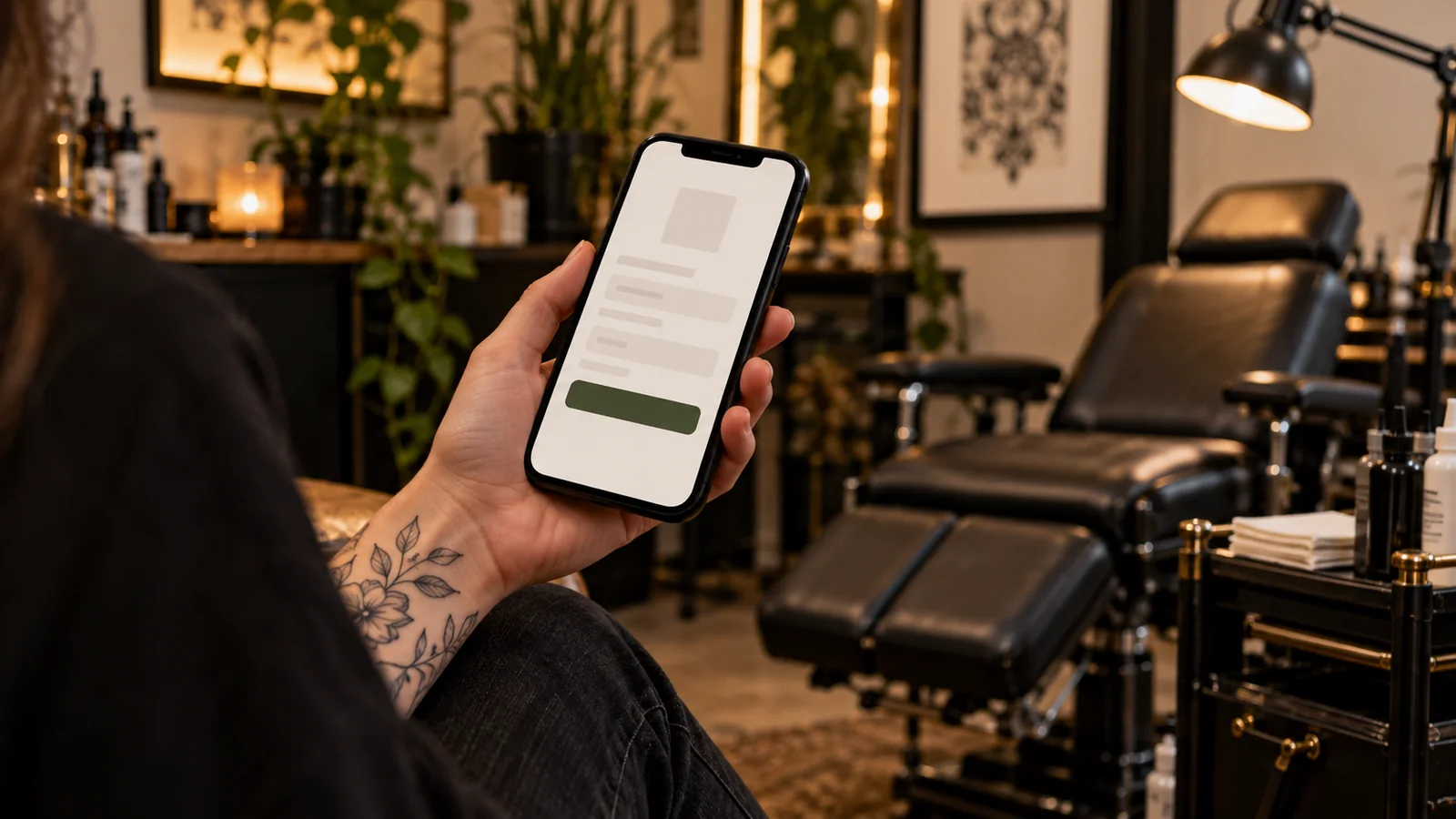
What the deposit is paying for
A deposit holds the date, so you aren't keeping a Saturday open on someone's word. It pays for the drawing time that happens before the client ever sits down. And it comes off the final price. In US search data, “does a tattoo deposit go towards the tattoo” gets more searches than “how much is a tattoo deposit”, so put that last point in writing.
Those three jobs pull in different directions. The date is worth the same whether the piece is palm-sized flash or a full back. The drawing time isn't. Taking the deposit before you start drawing also protects the design itself, which is covered in sending designs in advance.
How much a tattoo deposit should be, by job size
For flash and small custom pieces, a flat amount is easy to explain and easy to remember. For larger work, a percentage of the session price grows with the hours you're putting into the drawing. For multi-session pieces, take a deposit on each session and let each one come off that session's price. It keeps the math simple when a sleeve stretches over five months and someone asks what's been paid.
The numbers below are examples to show the math. There's no reliable published average for tattoo deposits, and what works for a busy shop in Austin won't match a private studio in a small town.
| Booking | How to set it | Example |
|---|---|---|
| Flash or a small piece, under an hour | Flat amount | $50 on a $150 piece |
| Custom piece, one session of a few hours | Share of the session price | 30% of $600 = $180 |
| Full day | Share of the day rate | 25% of $1,400 = $350 |
| Multi-session piece such as a sleeve | A deposit on each session | $200 per session, each one off that session's price |
| Returning client you trust | Smaller deposit, or none | Your call, within what your plan allows (see below) |
Run two checks on any number. Losing it should sting enough that a client thinks twice before ghosting. It should also cover your drawing time if they disappear after seeing the design. If those point to different amounts, take the higher one. UK clients also search for it as a booking fee. The math is the same.
How US clients pay, and the catch with each
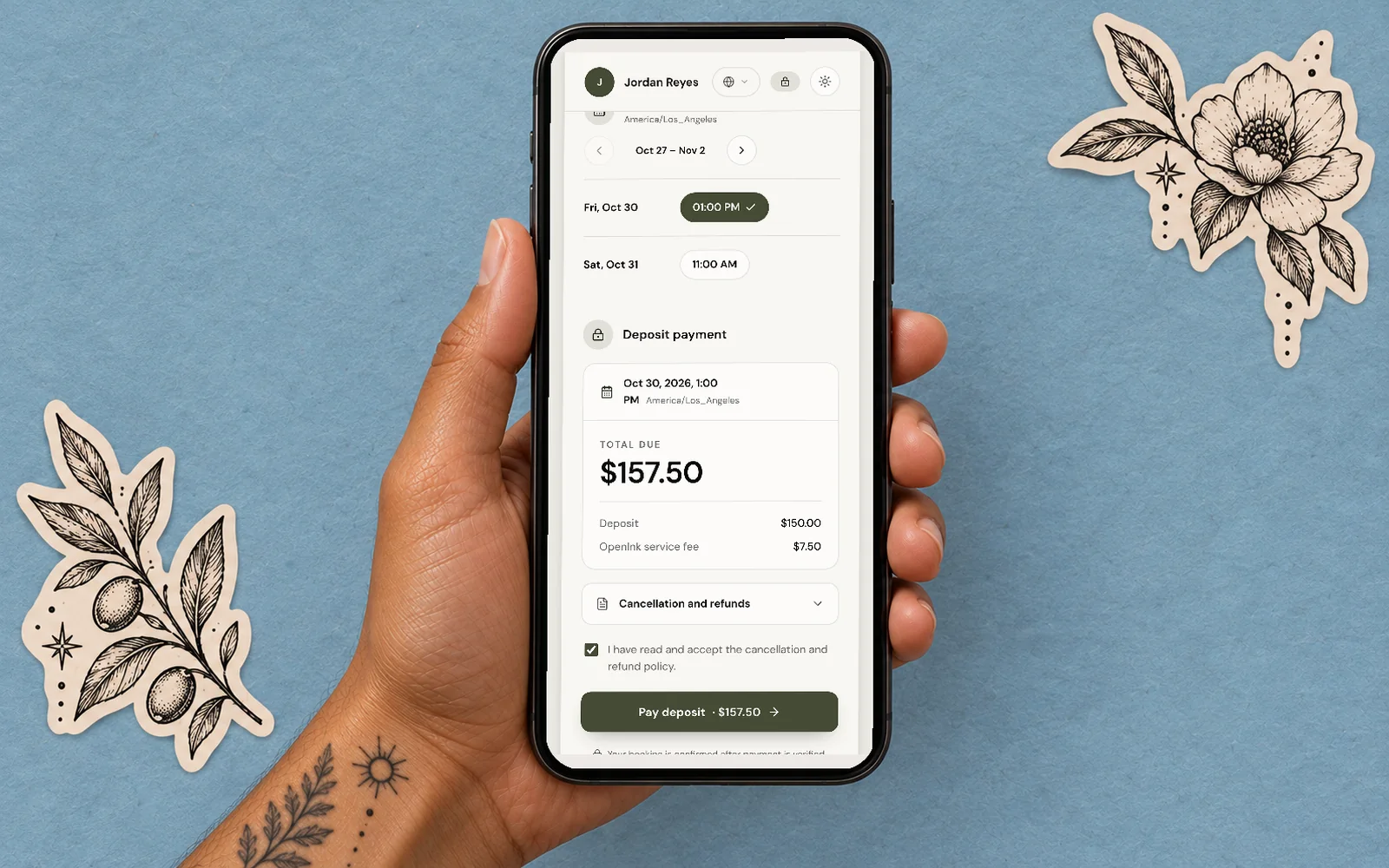
Start typing “do tattoo artists take” into Google and it finishes the question with Venmo, Zelle, Apple Pay and credit cards. Those are the options clients ask about, and each has a catch:
- Venmo charges a personal account 2.99% to receive a payment the sender marks as goods and services, and a business profile 1.9% + $0.10 (Venmo's fee page). On a $150 deposit, that's $4.49 or $2.95 off the top.
- Zelle payments can't be reversed, and Zelle's own FAQ tells people to send money only to people they know and trust (Zelle FAQ). That's fine for regulars. A new client who found you on Instagram has every reason to hesitate.
- Cards, Apple Pay and Google Pay go through a checkout page the client recognizes. Card payments carry processing fees, and a client can dispute a charge with their bank.
Google also suggests “tattoo deposit scam” as people type, in the US, the UK and Australia. That's the mood a first-time client brings to a request for money sent to a stranger's personal account, and a proper checkout page answers it better than any reassurance in a DM.
How clients pay in Canada, the UK and Australia
| Country | What clients often use | In OpenInk Studio |
|---|---|---|
| US | Venmo, Zelle, Cash App, Apple Pay, cards | Cards, Apple Pay, Google Pay and Link online; Stripe may add Cash App Pay and Amazon Pay. Venmo, Zelle and Cash App transfers get recorded by hand. |
| Canada | Interac e-Transfer, cards | Cards, Apple Pay and Google Pay online. An e-Transfer gets recorded by hand. |
| UK | Bank transfer, PayPal, cards | Cards, Apple Pay and Google Pay online; Stripe may also show Pay by Bank and Revolut Pay. Bank transfers and PayPal get recorded by hand. |
| Australia | PayID, Afterpay, cards | Cards, Apple Pay and Google Pay online. PayID gets recorded by hand. Afterpay isn't supported. |
In Canada, Interac e-Transfer is the default way people send each other money: Interac reports 1.4 billion e-Transfer transactions in 2024 (interac.ca). Expect clients to offer it. In Australia, PayID lets clients pay to a phone number, email address or ABN through more than 100 banks and other financial institutions. If you take PayID, tell clients the only payment details that count are the ones you send them yourself. The official PayID site warns that emails or texts claiming to come from PayID are scams (PayID).
When the client has already paid another way
Sometimes the money arrives before the link does. A regular sends $100 by Zelle, or a client in Toronto e-Transfers the deposit the minute you agree on a date. In OpenInk Studio you log that against the booking with Record in-person payment. The label says in person, but it covers any money you took outside OpenInk, a transfer sent ahead included. It's free, with no service fee, and it counts toward your income report alongside the card payments.
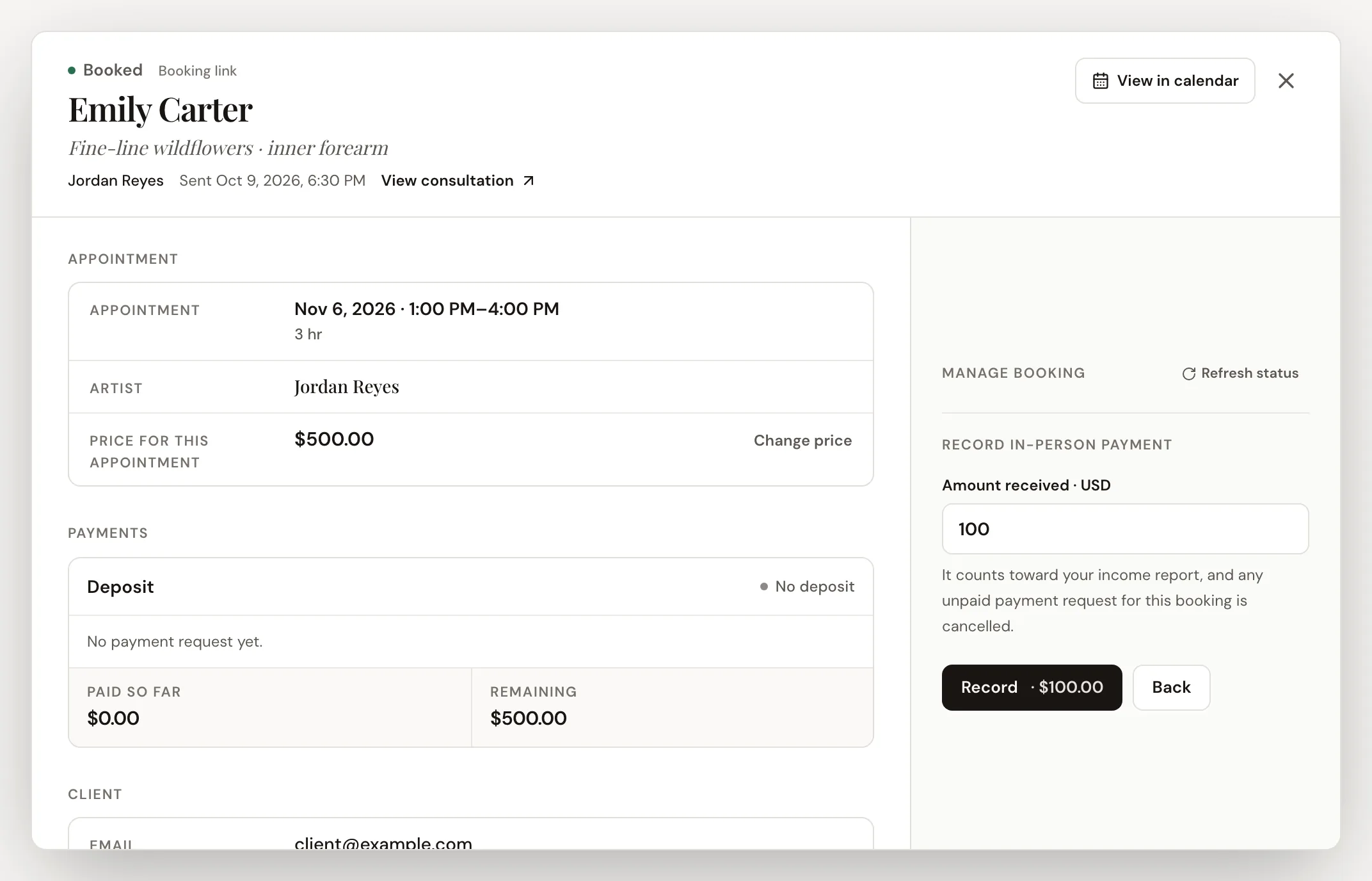
Your plan decides how that works. On Free, every booking link takes a deposit online, although a client who has already paid you one deposit through OpenInk can book later sessions without one. Sending a link with No deposit, so the transfer can be recorded instead, needs a paid plan or the 14-day trial. The same button covers the balance: cash at the counter or a payment on your own card reader goes in the same way, so the month's numbers stay complete.
Refunds, no-shows and moving dates
How much comes back after a cancellation, what happens after a no-show and how many times a date can move all belong in your written rules. There's a deposit policy you can copy on our deposits page, and the no-show guide covers reminders and late cancellations.
If several artists work under your roof, decide as well how deposits and refunds count toward each artist's share. How tattoo artists get paid walks through a month of that, with a worked example.
Deposit questions artists get asked
- How much a tattoo deposit should be
- Enough that losing it stings, and enough to cover your drawing time. For small pieces that's usually easiest as a flat amount; for larger work, a share of the session price. The table above has worked examples in dollars.
- Whether the deposit goes toward the tattoo
- It should, and your rules should say so. In OpenInk Studio the deposit always comes off the price of that session, and the client's terms state it before they pay.
- Taking deposits through Venmo or Zelle
- You can, as long as you keep a record. In OpenInk Studio, log those payments with Record in-person payment so your income report includes them. Deposits through the booking link are paid by card or digital wallet through Stripe; Venmo and Zelle aren't connected.
More from the blog
- Tattoo no-shows: deposits, written rules and reminders that keep the chair full
The few reasons clients don't turn up, the fix for each one, a reminder and a no-show message to copy, and what to do with the empty chair.
- Tattoo consent form: what goes in it, state age rules and a template
The sections a consent form needs, the state rules that change it, and a template to copy. Plus the parts that still happen at the counter on the day.
- How to send designs in advance without handing them to another shop
Plenty of clients want to see the drawing before they sit down. Here's how to show it without giving it away, and where copyright helps and where it doesn't.
- Tattoo aftercare sheet: a template for clients, and the follow-up after the session
A template clients can follow at home, the states that want aftercare in writing, and a follow-up schedule that ends with an honest review request.
- How do tattoo artists get paid: commission, booth rent and guest spots
Who collects the money under commission, booth rent and guest spots, what the split should be calculated on, and how to close out a month without arguments.