

Published
Tattoo aftercare sheet: a template for clients, and the follow-up after the session
Your client nods through the aftercare talk with fresh ink, a rush of adrenaline and a forearm in plastic wrap. By the time they're home, they remember “wash it” and “don't pick it,” and not much else. Your tattoo aftercare sheet is what they'll check at 11 p.m. when the wrap starts to look cloudy, and in Florida and Texas, handing one over is part of the rules.
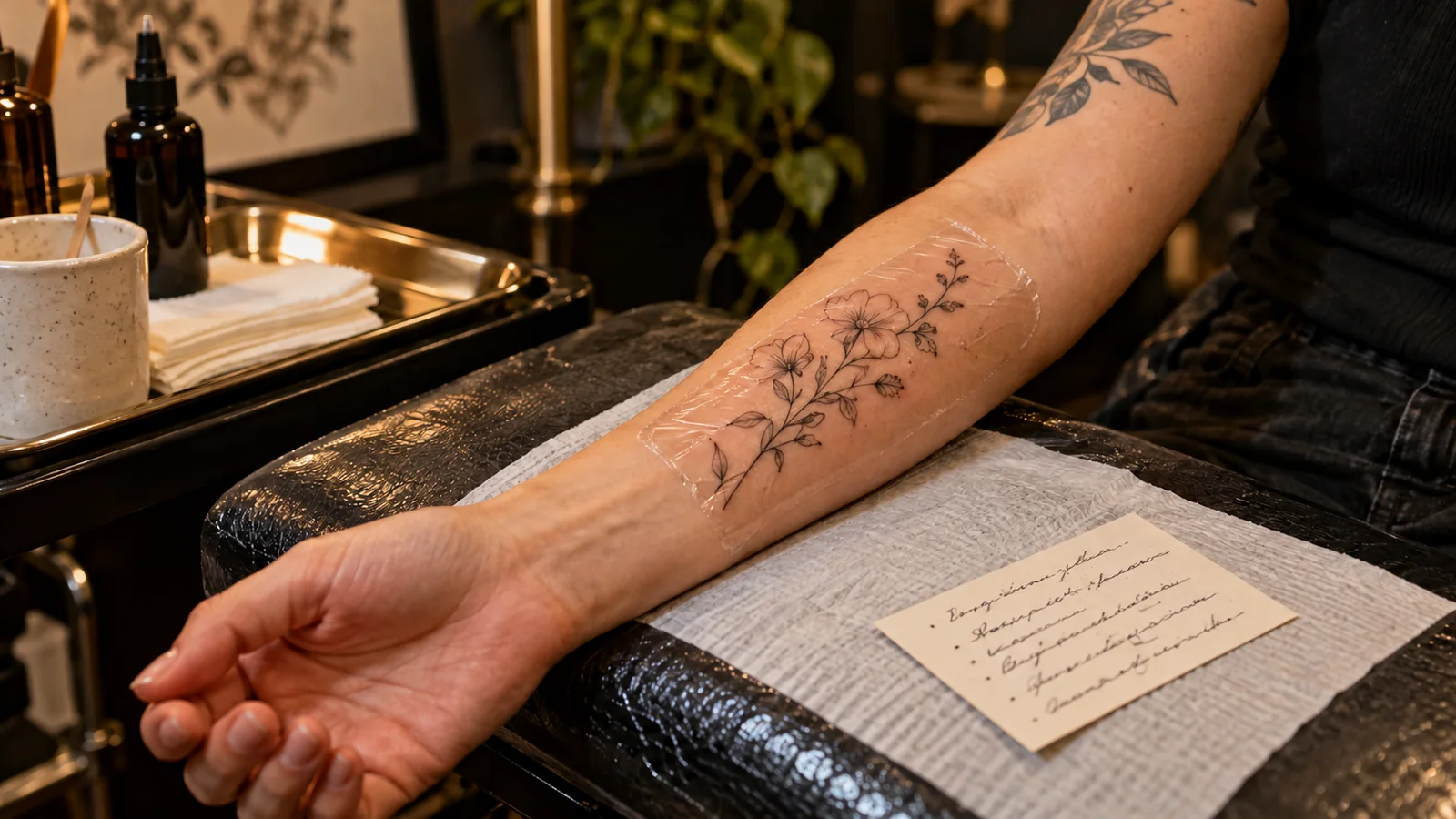
Why aftercare goes in writing
Memory is the first reason. The talk happens at the end of a long session, when the client is tired and mostly thinking about photos. The second is the rulebook. Florida requires artists to give aftercare information both verbally and in writing. Texas requires the client record to include a statement, signed by the client, that they received the written care instructions, read them and understood them. That statement fits naturally on your consent form; see what goes into a tattoo consent form.
What to put on your tattoo aftercare sheet
Write it for the client at home, alone, with the tattoo in front of them. Use short steps, in the order they'll happen. And use your own process. If you put on adhesive film (second skin) and the shop down the road uses plastic wrap, the timings are different, and a copied sheet will contradict what you told the client in the chair.
- Say what's covering the tattoo right now, plastic wrap or adhesive film, and when and how to take it off.
- Explain washing: how often, what kind of soap, lukewarm water, and patting dry with a clean paper towel.
- Name the ointment or unscented lotion you recommend, and how thin and how often to apply it.
- List what to avoid until it's healed: soaking in baths, pools, hot tubs or the sea, direct sun, picking at flakes, and clothes or workouts that rub the spot.
- Describe what's normal, so nobody panics over redness, flaking or itching in the first days and weeks.
- Spell out when to see a doctor, in plain words, and ask clients to tell you as well.
- Say when you want to see it healed, and whether the first touch-up is free.
- Give one way to reach you, the channel you actually answer.
Tattoo aftercare sheet template
Edit it to match how you work: your covering, your products, your timings. It's a starting point, not medical advice. Fill in every bracket before you print or send it.
AFTERCARE FOR YOUR NEW TATTOO
[Studio name] · [Artist name] · [Phone / Instagram / email]

THE FIRST [NUMBER] HOURS
Leave the [plastic wrap / adhesive film] on for [time].
Wash your hands before you take it off. [Adhesive film: peel it back slowly in the shower, low along the skin.]
Wash the tattoo gently with lukewarm water and [unscented liquid soap].
Pat it dry with a clean paper towel. Don't rub.

WHILE IT HEALS (ABOUT [NUMBER] WEEKS)
Wash it [number] times a day, the same way.
Apply a thin layer of [product] [number] times a day. Thin means it shouldn't look shiny.
Let it flake. Don't pick, peel or scratch it, even when it itches.
Wear loose, clean clothes over it.

AVOID UNTIL IT'S HEALED
Baths, pools, hot tubs, the sea and saunas.
Direct sun and tanning beds. Once it's healed, put sunscreen on it.
Workouts that rub or stretch the tattoo, for [number] days.
Pets, and other people's hands.

WHAT'S NORMAL
Some redness and tenderness, and a little clear or ink-colored fluid in the first days.
Flaking and itching while it heals. It can look dull or cloudy for a while.

WHEN TO SEE A DOCTOR
Redness, heat or swelling that keeps spreading or getting worse.
Pus or a bad smell.
Fever, chills or red streaks running from the tattoo.
If you notice any of these, see a doctor and let us know.

TOUCH-UPS
We'd like to see it healed, around [number] weeks after your session.
[Your first touch-up within [number] months is free / costs [amount].]
Book it by [how].

QUESTIONS
Message [artist name] at [contact]. We'd much rather hear from you early.
Hand it over on paper, then send it by email
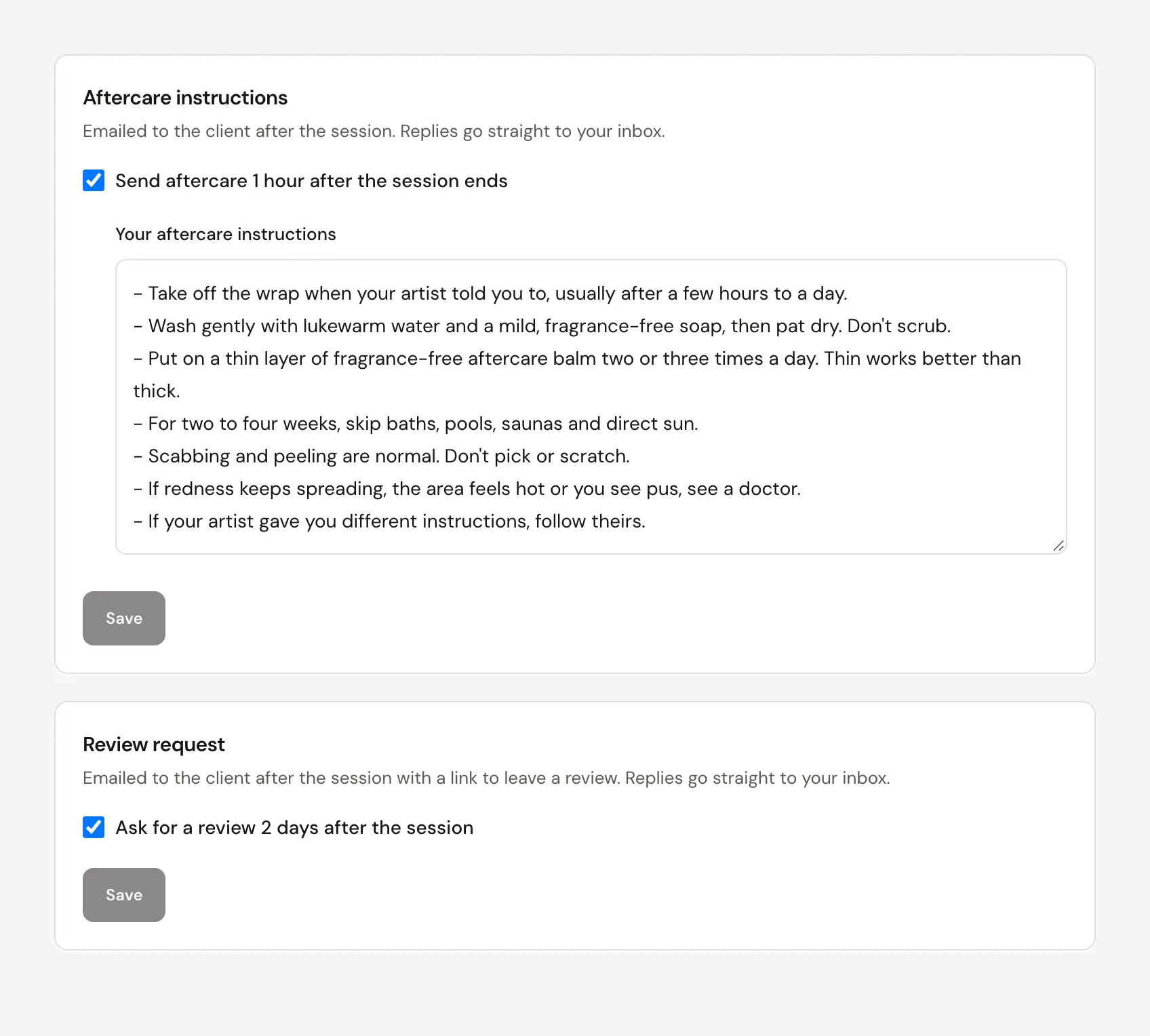
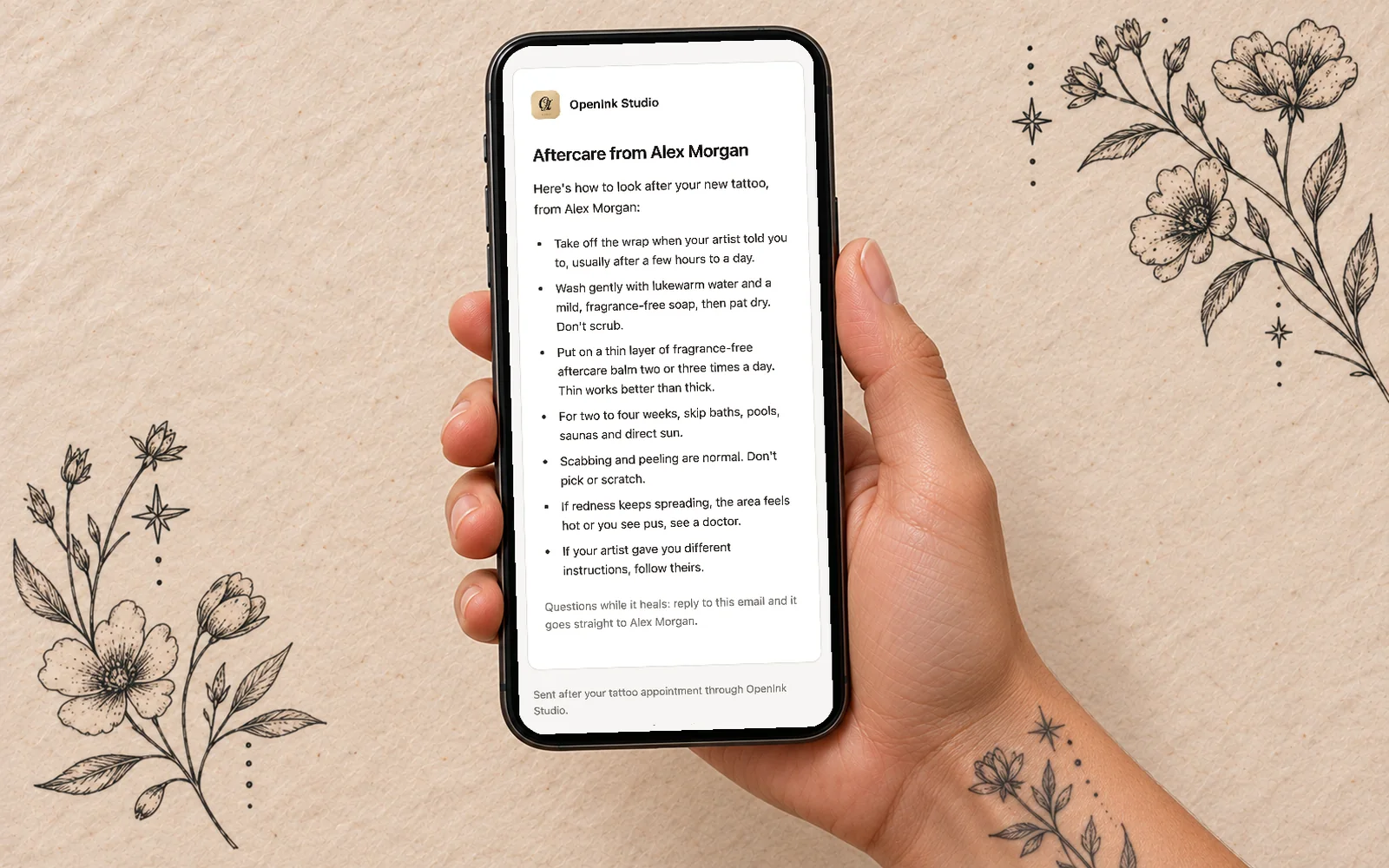
Give the sheet on paper at the counter (UK searches also call it an aftercare leaflet) and send the same text by email that day. The paper goes on the fridge. The email is the one they find on their phone at 11 p.m. Some artists also hand out a business-card-sized aftercare card with the lines that matter most and a phone number, for clients who will lose a full page by Tuesday. The email leaves a record that written instructions went out, which helps if an inspector asks how you meet the written requirement.
Check in twice: early, and once it's healed
The aftercare email covers the first night. Two more messages are worth putting in your calendar. A few days in, when the flaking and itching start, a short check-in catches problems early and reminds the client you're easy to reach. Once it's healed, ask for a photo and offer the touch-up. Healed photos are also the ones that show what your linework really looks like, so they're the ones worth posting.
Keep both messages as short and friendly as your day-before reminder. Neither one needs a reply unless something looks wrong.
Two check-in messages to copy
Send them by text, DM or email. Change the parts in brackets.
A FEW DAYS AFTER
Hi [name], it's [artist] from [studio]. Just checking in on your tattoo. Flaking and itching around now are normal. If anything looks off, send me a photo and I'll take a look.

ONCE IT'S HEALED
Hi [name], your tattoo should be fully healed by now. When you get a minute, send me a photo in daylight. If any spots need a touch-up, I can fit you in [timeframe], [free / for amount].
Ask every client for a review, the same way
Two days after the session, the visit is fresh and the tattoo is still healing, so a review written then is about the experience: the consultation, the studio, how you treated them. Healed results come later, one more reason to ask for that healed photo.
For US clients, Google is still where most people read reviews. In BrightLocal's Local Consumer Review Survey 2026, a survey of 1,002 US consumers, 71% said they use Google to read reviews of local businesses, and 74% said they only care about reviews written in the last three months. A few reviews every month count for more than a burst after one good month.
Google's rules for business owners are short. Don't offer anything in exchange for a review, whether that's money off the next session or a free tub of balm. Don't ask only the clients you think were happy. Don't discourage negative reviews, and don't pressure people to write one while they're still at the studio (Google's review policy). You can ask every client and share a direct review link (Google Business Profile help). In the US, the FTC's rule on consumer reviews also bans incentives for reviews that express a particular sentiment (16 CFR 465.4) and bans hiding negative reviews while presenting the rest as all your reviews (16 CFR 465.7).
OpenInk Studio's review email links to a review page on OpenInk, and you pick which reviews appear in the client reviews section of your tattoo artist website. Showing a selection is fine as long as you don't present it as every review you've received. The review email doesn't send anyone to Google. If you want Google reviews too, add your Google review link at the end of your aftercare text. The aftercare email goes out after every session once the switch is on, so the link reaches every client, which is how Google wants you to ask.
Aftercare questions from other artists
- Printable tattoo aftercare instructions
- Print the template above on a single letter-size sheet and keep a stack at the counter. One page is the limit. If yours runs longer, cut the explanations and keep the steps.
- Separate sheets for plastic wrap and adhesive film
- Keep one version for each covering, or one sheet with the two clearly split, and tick the one you used before you hand it over. Instructions for both run together in one paragraph invite mistakes, like a client leaving wrap on for as long as film is meant to stay.
- When a client messages that it looks infected
- Ask for a photo in daylight, don't try to diagnose it over DM, and tell them to see a doctor if they describe spreading redness, heat, pus, fever or red streaks. Note the date and what you told them.
More from the blog
- Tattoo no-shows: deposits, written rules and reminders that keep the chair full
The few reasons clients don't turn up, the fix for each one, a reminder and a no-show message to copy, and what to do with the empty chair.
- Tattoo consent form: what goes in it, state age rules and a template
The sections a consent form needs, the state rules that change it, and a template to copy. Plus the parts that still happen at the counter on the day.
- How to send designs in advance without handing them to another shop
Plenty of clients want to see the drawing before they sit down. Here's how to show it without giving it away, and where copyright helps and where it doesn't.
- How much is a tattoo deposit: amounts by job size and how clients pay
Flat amounts, percentages and multi-session pieces worked through in dollars, plus the payment apps clients reach for and the catch with each one.
- How do tattoo artists get paid: commission, booth rent and guest spots
Who collects the money under commission, booth rent and guest spots, what the split should be calculated on, and how to close out a month without arguments.