

Published
Tattoo consent form: what goes in it, state age rules and a template
In Florida, the record you keep for every client has to show your name, the client's name, age and date of birth, where the tattoo went, the date, and two signatures: theirs and yours. It stays on file for two years. Most shops cover all of that with a tattoo consent form the client signs at the counter, often while you're setting up the station and they're racing through the health questions.

Keep the consent form apart from your booking form
Your booking form comes first. It collects the idea, placement, size, references and budget, so you can decide whether to take the job and what to quote. The consent form comes later, once the date is set and the design is close to final. That's where the client confirms their age, tells you about their health, reads the risks and agrees to look after the tattoo.
A third record often gets mixed in with these: which version of the design the client approved. That belongs with the design itself, dated, so nobody argues about it in the chair. There's more on that in how to send designs in advance. Keep all three apart: a client who is still choosing between two ideas has no reason to list their medications for you yet.
What goes into a tattoo consent form
These are the sections most forms cover, and why each one is there. If your state, county or council publishes its own list, follow theirs and use this one to fill the gaps.
Age and ID
Ask for the date of birth, then leave a line for the artist to write down which ID they checked. Texas requires the artist to record the client's age, date of birth and the type of ID, and the ID has to be government-issued, with a photo and the date of birth on it. A form filled in at home can't check anyone's ID. That line gets filled in at the counter.
Health questions
Yes/no questions with room for details get better answers than one open box. The usual ones: allergies (latex, pigments, ointments), blood thinners or other medication that affects bleeding, conditions that slow healing such as diabetes, skin problems where you'll be working, pregnancy or breastfeeding, and recent drinking. The answers tell you whether to go ahead today or ask the client to check with their doctor first.
Risks, in plain words
Texas makes artists explain four risks, out loud and in writing, before they start: pain or discomfort, that the tattoo is permanent, infection, and a possible allergic reaction to the pigments or other materials. Even where your state doesn't spell it out, those four are a good place to start. Write them the way you'd say them. “This is permanent” gets read. “Irreversible pigment deposition” gets skimmed.
Aftercare
Add a line where the client confirms they've received your aftercare instructions, read them and understood them. Texas requires that statement in the client record, next to the client's signature, and Florida requires aftercare information both verbally and in writing. The instructions themselves go on their own sheet; here's a tattoo aftercare sheet you can adapt.
Photos
Ask whether you can photograph the tattoo and post it, and whether they want to be tagged. Give it a separate tick box so a “no” here doesn't hold up the rest of the form.
How they are on the day
Finish with a short declaration: they've eaten, they aren't under the influence of alcohol or drugs, and the answers above are still true. In Texas, nobody who appears to be under the influence of alcohol or drugs may be tattooed. If the declaration and the person in front of you don't match, go with the person.
Send it two days ahead, then go over it at the counter
A form handed over at the counter gets read in the time it takes you to set up. Sent two days before, it gets read at home, with time to message you about that medication question. You hear about the blood thinners on Thursday, while there's still time to move the session, and not on Saturday with the stencil already on.
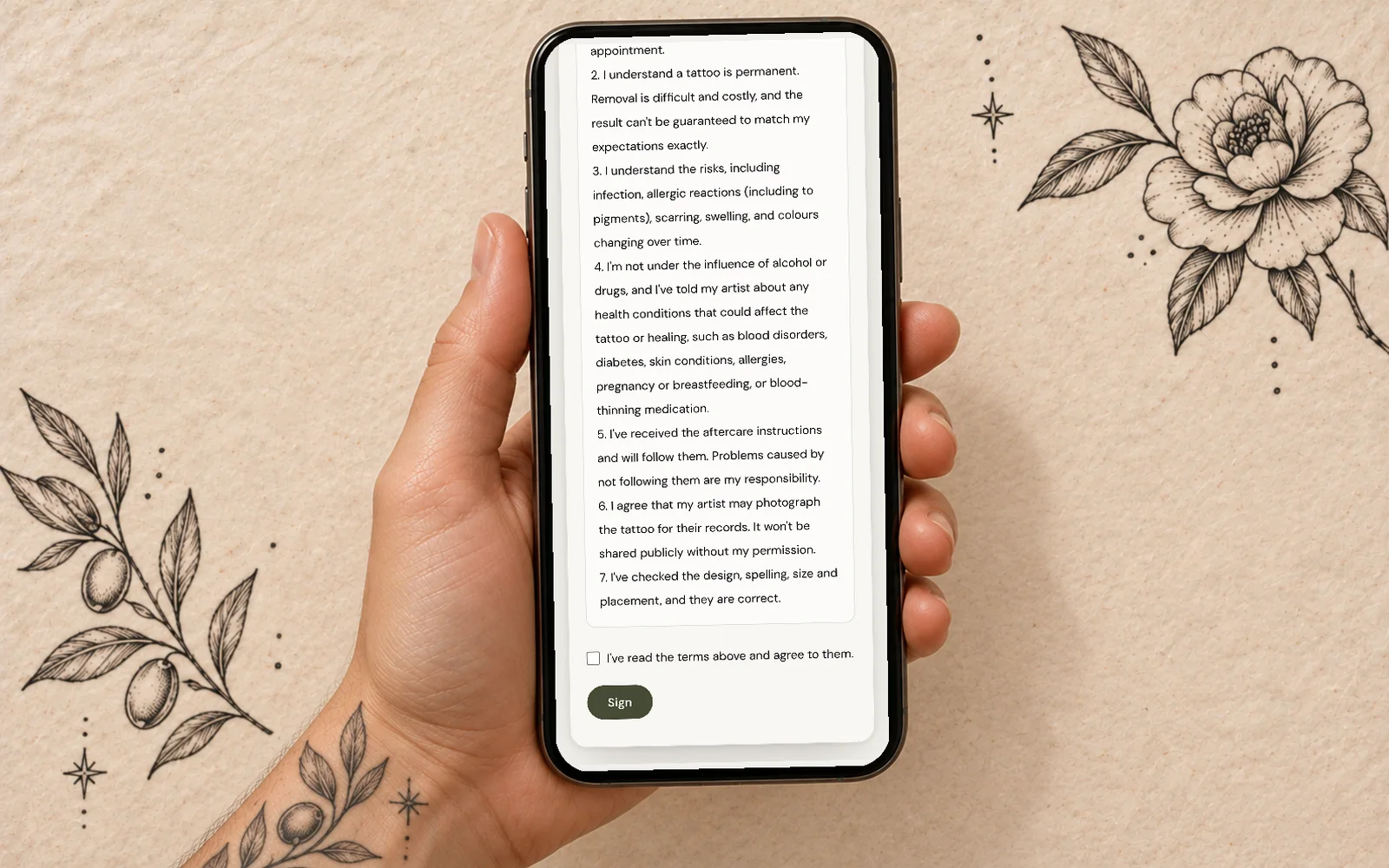
Sending early doesn't replace the day itself. Florida's record carries the date of the procedure, and Texas wants the risks explained, out loud and in writing, before you begin. Treat the early form as the client's answers, then go through it together when they arrive: confirm nothing has changed, check the ID, and collect whatever signature your rules ask for. If you also send a reminder the day before, the consent form lands a day earlier, so the two messages don't compete for attention.
Age rules and record keeping depend on where you work
Most of the form travels well. The age section doesn't. A 17-year-old with a parent can legally get tattooed in Florida with the right paperwork, can only get a cover-up in Texas, and can't be tattooed at all in California or in Great Britain.
| Where | Clients under 18 | Records |
|---|---|---|
| Florida | Under 16: no tattoos, apart from medical or dental work by a licensed doctor or dentist. 16 or 17: a parent or legal guardian comes along, both show government photo ID, the parent signs a notarized consent on form DH 4146 and shows proof of guardianship. | A client record with the client's and the artist's signatures, kept for 2 years. Aftercare given verbally and in writing. |
| Texas | Only to cover an existing tattoo with obscene or offensive content, gang or drug references, or other markings the parent considers in the minor's best interest to cover. The parent is there in person, signs an affidavit, shows the minor's ID and proof of being the parent or guardian, and leaves a description or photo of the tattoo being covered. | Risks explained verbally and in writing before you start. The record includes the client's signature and the aftercare statement and is kept at least 2 years. |
| California | Tattooing anyone under 18, or offering to, is a misdemeanor. Parental consent doesn't change that. | Ask your local health department what it wants to see. |
| England, Scotland and Wales | Illegal under 18 under the Tattooing of Minors Act 1969, except for medical reasons. Parental consent doesn't change that. Northern Ireland has its own 1979 order. | Requirements vary by area. Ask your local council. |
In Canada and Australia the rules differ from one province or state to the next, so check with your provincial or state health authority before you use any template, including the one below.
A consent form template to copy
Tattoo consent form template
A starting point, not legal advice. Change everything in brackets and check it against your state, county or council rules before a client signs it.
TATTOO CONSENT FORM
[Studio name] · [Address] · [License number, if your state issues one]

CLIENT
Full name:
Date of birth:
Phone or email:
Artist:
Date of appointment:
Placement and short description of the tattoo:

AGE AND ID (completed by the artist at the studio)
Type of photo ID checked:
Checked by:
[Florida, client aged 16 or 17: attach the notarized form DH 4146 and note the parent's or guardian's ID.]

HEALTH (answer yes or no, and add details for any yes)
Allergies to latex, pigments, ointments or metals: Yes / No
Blood thinners or other medication that affects bleeding: Yes / No
Diabetes, a heart condition or anything else that slows healing: Yes / No
A skin condition, scar, mole or irritation where the tattoo will go: Yes / No
Pregnant or breastfeeding: Yes / No
Alcohol or recreational drugs in the last [24] hours: Yes / No
Details:

RISKS
I understand that:
- Getting tattooed involves pain or discomfort.
- The tattoo is permanent, and removing it later is not guaranteed.
- The skin can become infected, especially if I don't follow the aftercare instructions.
- I could have an allergic reaction to the pigments or other materials.
- How the tattoo heals depends on my skin, the placement and my aftercare.

AFTERCARE
I have received a copy of the written aftercare instructions. I have read them and I understand them. I will follow them and contact the studio if I'm worried about how the tattoo is healing.

PHOTOS
[ ] You may photograph my tattoo and post it online.
[ ] You may tag me. Handle:

DECLARATION
I am [18] or older. I have eaten today and I am not under the influence of alcohol or drugs. The answers above are true. I have had the chance to ask questions, and I agree to be tattooed by [artist name] at [studio name].

Client signature:                    Date:
Artist signature:                    Date:
What still happens in person
The open question with any digital tattoo consent form is whether a ticked box counts as a signature. US federal law (the ESIGN Act) treats an electronic sound, symbol or process as a signature when the person adopts it with the intent to sign. Florida's and Texas's health rules still say “client signature”, though, and whether an inspector accepts a ticked box with a timestamp is up to the health department in your area. Ask them before you drop paper completely.
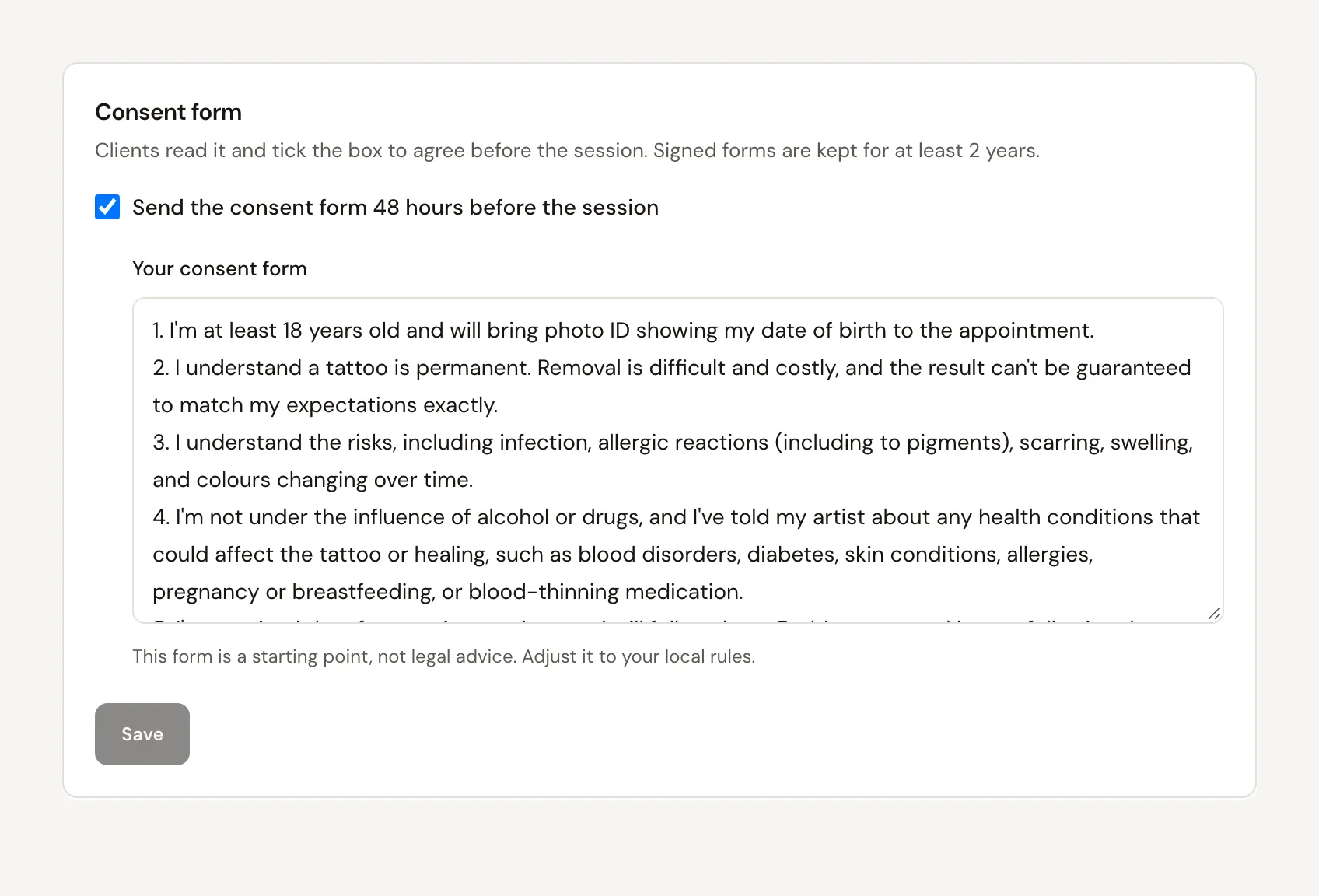
OpenInk Studio collects consent with a tick box. It doesn't take handwritten signatures, it doesn't check ID, and it has no step for a parent or guardian to sign. Cover those at the studio:
- Check the client's government photo ID when they arrive and note the type of ID. In Texas that goes into the client record.
- If your health department wants a handwritten signature, print your form and have the client sign it at the counter. Keep the paper as long as your rules require, which is two years in Florida and Texas.
- For a 16- or 17-year-old in Florida, the parent comes in person with ID and the notarized form DH 4146, and you keep that paper. In Texas, under-18 work is limited to cover-ups with the parent there and a signed affidavit. In California and Great Britain the answer is no.
- If something changed since the client ticked the box (a new prescription, say), write it down and decide before you start whether to go ahead.
If a client says the email never arrived, use Copy signing link and send it by text or DM. If a session doesn't need a form under your rules, Skip signing marks it as skipped so it stops showing as waiting.
Common questions about consent forms
- A tattoo consent form for minors
- It depends entirely on the state or country. Florida allows 16- and 17-year-olds with a parent present and a notarized consent on form DH 4146. Texas allows only cover-ups of certain existing tattoos. California and Great Britain don't allow under-18 tattoos at all, with or without a parent.
- How long to keep signed forms
- Florida and Texas both require client records to be kept for two years. If you work somewhere else, ask your health department or council. OpenInk Studio keeps signed forms for at least two years, and any paper you collect at the counter is yours to store.
- Paper or digital consent forms
- Sent ahead, a form gets read at home, with time to think about the health questions. Paper may still be what your inspector expects. Doing both covers you: the form goes out two days early, and a printed copy gets signed on the day.
More from the blog
- Tattoo no-shows: deposits, written rules and reminders that keep the chair full
The few reasons clients don't turn up, the fix for each one, a reminder and a no-show message to copy, and what to do with the empty chair.
- How to send designs in advance without handing them to another shop
Plenty of clients want to see the drawing before they sit down. Here's how to show it without giving it away, and where copyright helps and where it doesn't.
- How much is a tattoo deposit: amounts by job size and how clients pay
Flat amounts, percentages and multi-session pieces worked through in dollars, plus the payment apps clients reach for and the catch with each one.
- Tattoo aftercare sheet: a template for clients, and the follow-up after the session
A template clients can follow at home, the states that want aftercare in writing, and a follow-up schedule that ends with an honest review request.
- How do tattoo artists get paid: commission, booth rent and guest spots
Who collects the money under commission, booth rent and guest spots, what the split should be calculated on, and how to close out a month without arguments.