

Published
How do tattoo artists get paid: commission, booth rent and guest spots
It's the last day of the month. One artist took three deposits through the shop's account, collected a balance on the card reader and refunded a client who moved away. Another took most of her balances in cash and kept them in an envelope in her drawer. Before anyone gets paid, somebody has to decide which of those numbers the split applies to.

How tattoo artists get paid at a shop: the common setups
| Setup | Who collects from the client | How the shop gets paid |
|---|---|---|
| Commission | Usually the shop, into its own account | Keeps an agreed share of what each artist brings in and pays out the rest |
| Booth rent (chair rent in the UK) | The artist, into their own account | A fixed rent per week or month, however much the artist earns |
| Hybrid | Depends on the deal | Part rent, part share, each lower than it would be on its own |
| Guest spot | Either, by agreement | A daily fee or a share of what the guest takes in that day |
| Employee | The shop | Keeps the revenue and pays a wage through payroll |
The names shift by country. In Google's search suggestions, US searches lean toward booth rent, UK searches toward chair rent, and Australian searches show both. Whatever you call it, write down which setup each artist is on. Month-end gets messy fast when an artist thinks they rent and the shop thinks they're on commission.
Guest spots have their own conventions. One arrangement you'll often hear about is a flat daily fee or a percentage of the guest's takings for the day, whichever comes out lower for the guest. With made-up numbers: if the host asks for $120 a day or 15%, a guest who takes in $600 pays $90, and one who takes in $1,500 pays $120. Florida also requires guest artists to register separately (Florida Administrative Code 64E-28.004), so check your own state's rules before you host anyone.
Work out the split from your own numbers
There's no official rate for commission or booth rent, and most of the figures passed around online don't say where they come from. Your own costs are a better starting point.
For commission, list what the shop puts in for each artist: the chair, the walk-ins you send their way, the front desk, supplies if you provide them, the marketing that brings people through the door. An artist who arrives with a waiting list needs the shop less than one who relies on walk-ins, and it's fair for the split to reflect that. For rent, divide your fixed costs by the number of stations and add a margin for how hard the space is to get.
To compare the two for one artist, take a typical month. If the artist brings in $8,000 and the shop keeps 40%, the shop gets $3,200. Put the same artist on $1,200 a month in rent and the shop gets $1,200, busy month or slow one, while the artist keeps everything above it. Commission moves with the artist's month. Rent stays put. Both figures are made up to show the math.
Agree on what the split is calculated on
Settling the percentage gets you halfway. The other half is the base it applies to, and that's the part people forget to agree on. Put these in writing:
- Run the split on money that actually came in. A $900 quote where the client paid $850 splits on $850.
- Count deposits and balances in the month they arrive. A deposit paid in March for a May session belongs to March.
- Take refunds off in the month they go out, from the artist whose client it was.
- Include cash and other outside payments. If the artist took the cash home, subtract it from what you pay them.
- Decide whether a deposit kept after a no-show gets split like any other income. The artist lost the day, so treating it the same is the simplest rule.
- Say whether needles, ink and other supplies come out before the split, out of the artist's share, or out of the shop's share.
- Say who carries card and platform fees. On OpenInk Studio bookings the client pays the service fee on top and the deposit or balance arrives in full, with nothing taken off.
A month of payouts, worked through
Two artists on commission at the same shop, one month. Card payments went into the shop's account, and in-person payments were recorded by hand. The names and numbers are made up for the example.
| Item | Mia | Dante |
|---|---|---|
| Deposits collected | $1,800 | $950 |
| Balances collected | $4,600 | $2,300 |
| Recorded as paid in person | $400 | $1,250 |
| Refunds | −$300 | $0 |
| Collected after refunds | $6,500 | $4,500 |
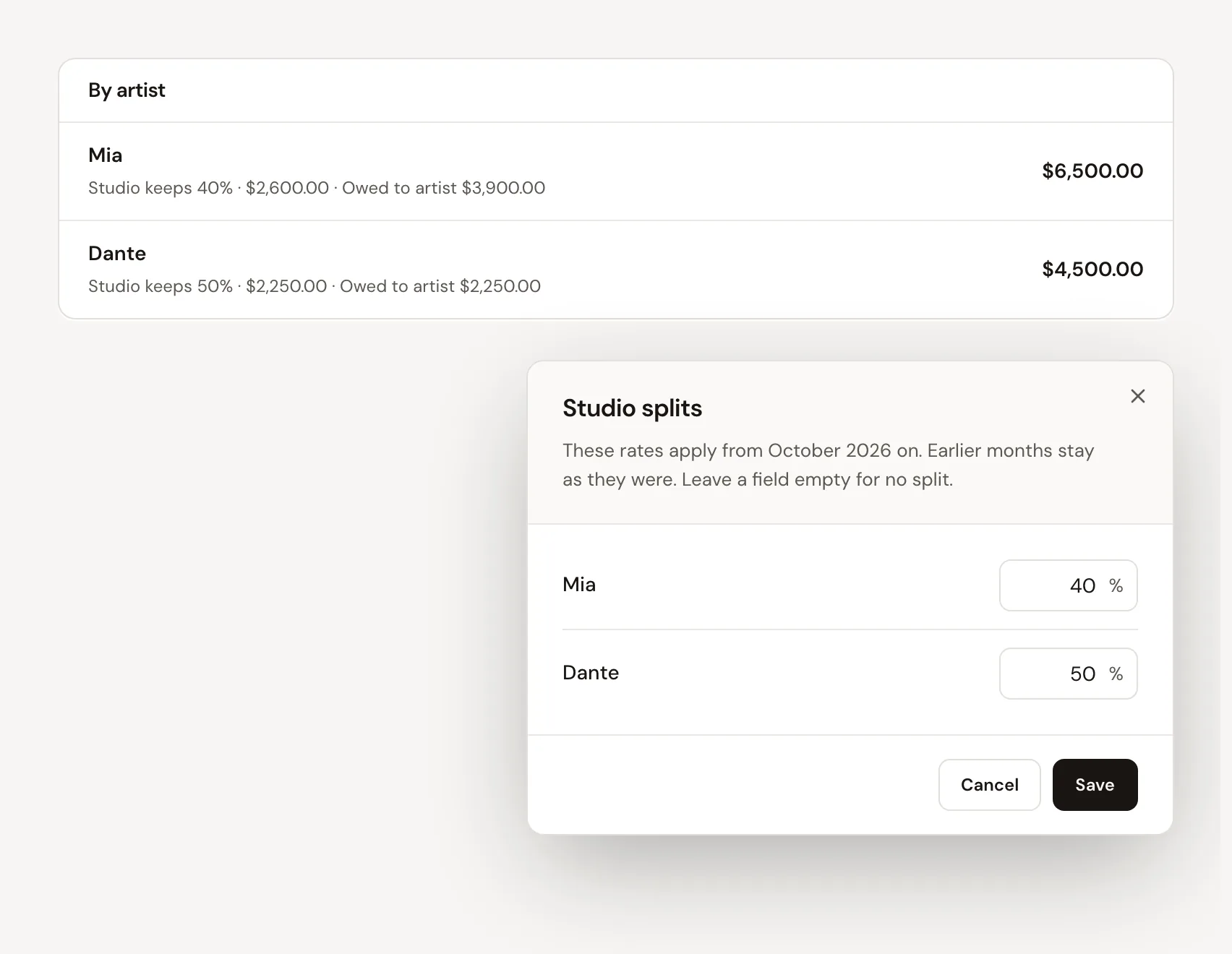
| Studio keeps | 40%: $2,600 | 50%: $2,250 |
| Owed to artist | $3,900 | $2,250 |
One adjustment the table can't make for you. Say Dante kept $600 of his in-person payments as cash in his own pocket. The shop then pays him $2,250 − $600 = $1,650, and the books still add up.
Contractor or employee
In the US, an artist you pay as an independent contractor gets a 1099-NEC, and an employee gets a W-2. Which one fits depends on how the work runs day to day. A shop that sets the schedule and the prices and provides the equipment looks more like an employer, whatever the contract says. An artist who sets their own hours and prices, brings their own supplies and keeps their own books points the other way.
In the UK, chair renters usually treat themselves as self-employed and handle their own tax. Whether HMRC would see it the same way depends on how much control the studio has over the work. Get an accountant's view before you rely on it. In Australia, if your artists invoice you under their own ABN, ask an accountant or the Fair Work Ombudsman whether the arrangement holds up as contracting.
Deposits that artists take into their own Venmo or PayPal sit outside the shop's books entirely. How much is a tattoo deposit covers those payment apps and the tax forms they send.
Closing the month
Pick a payout day and keep it. Then the routine is short:
- Record cash, card-reader and transfer payments against the booking on the day they happen, so nothing waits for the end of the month.
- Check the month's refunds and which artist each one belongs to.
- Export the settlement, subtract any cash artists kept, and pay.
- Send each artist their row so they can check it against their own records.
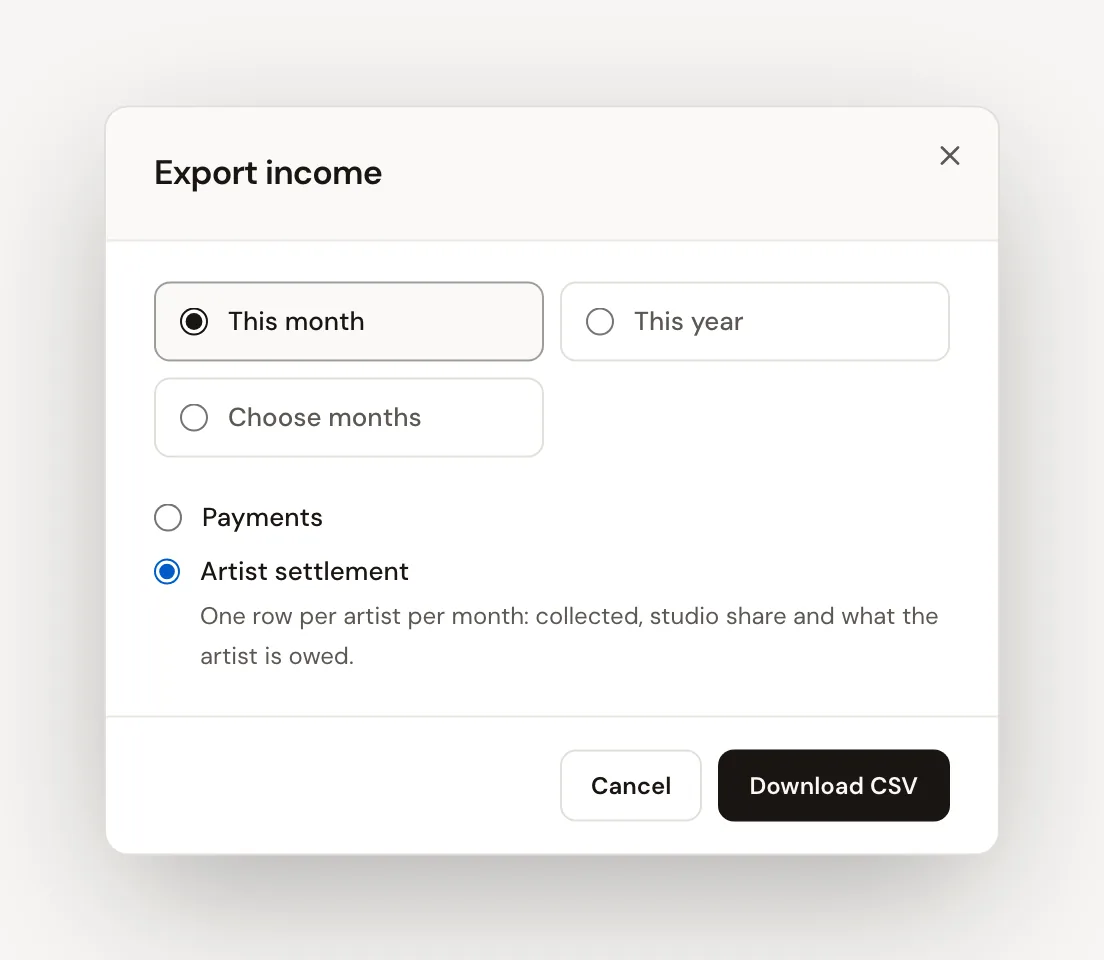
In OpenInk Studio, Export on the Income page offers Payments, with every payment line, or Artist settlement, with one row per artist per month showing collected, studio share and what the artist is owed. Choose this month, this year, last year or a range of months, then download the CSV.
Booth renters who handle their own bookings can run their own OpenInk Studio account with their own Stripe account, so their deposits never touch the shop's books and the shop only has the rent to collect. For a shop with several artists under one name, the page on tattoo studio management software explains how shared inquiries and bookings work in OpenInk Studio.
Questions owners ask about splits
- The usual tattoo artist commission percentage
- There isn't an official one. Work it out from what your shop provides and how much each artist relies on it. The example above uses 40% and 50% only to show the math.
- Changing an artist's split
- Agree on it in writing and pick the month it starts. In OpenInk Studio a new rate applies from the month you choose, and earlier months keep the rate they had.
More from the blog
- Tattoo no-shows: deposits, written rules and reminders that keep the chair full
The few reasons clients don't turn up, the fix for each one, a reminder and a no-show message to copy, and what to do with the empty chair.
- Tattoo consent form: what goes in it, state age rules and a template
The sections a consent form needs, the state rules that change it, and a template to copy. Plus the parts that still happen at the counter on the day.
- How to send designs in advance without handing them to another shop
Plenty of clients want to see the drawing before they sit down. Here's how to show it without giving it away, and where copyright helps and where it doesn't.
- How much is a tattoo deposit: amounts by job size and how clients pay
Flat amounts, percentages and multi-session pieces worked through in dollars, plus the payment apps clients reach for and the catch with each one.
- Tattoo aftercare sheet: a template for clients, and the follow-up after the session
A template clients can follow at home, the states that want aftercare in writing, and a follow-up schedule that ends with an honest review request.